Best Lead Qualification Questions for Voice AI
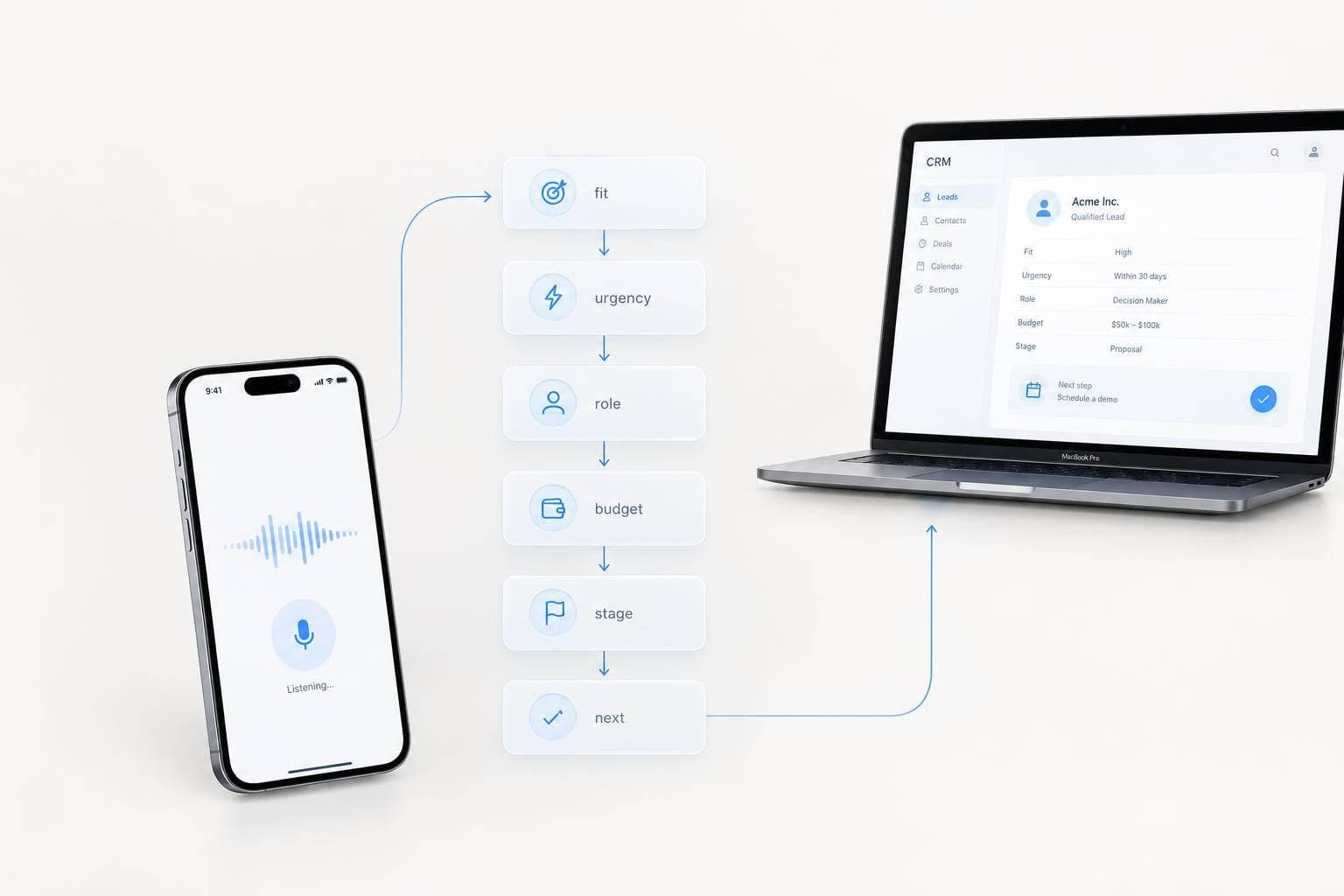
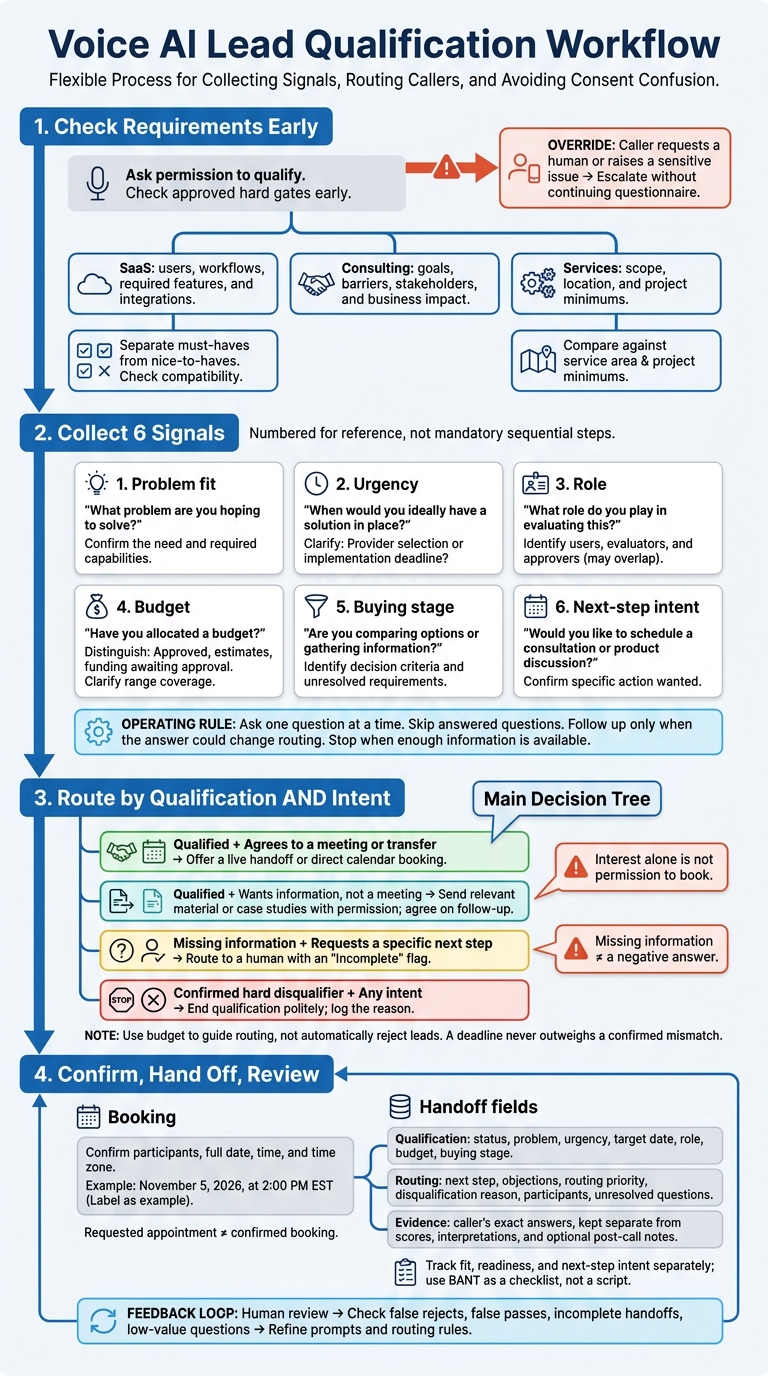
I build voice AI qualification around 6 signals: problem fit, urgency, role, budget, buying stage, and next-step intent. My rule: ask one question at a time, check firm requirements early, and stop asking once you have enough information to route the lead.
I tailor the questions to your business:
- SaaS: users, workflows, required features, and integrations.
- Consulting: goals, barriers, stakeholders, and business impact.
- Services: scope, location, and project minimums.
I use BANT as a checklist - not a script - and keep missing answers separate from negative answers. From there, I confirm whether the caller wants a meeting, information, or a human handoff. <u>Interest alone is not permission to book.</u>
For the handoff, I keep the caller’s answers separate from scores and optional post-call notes, confirm booking details, and review results to spot routing errors.
Voice AI Lead Qualification: 6 Signals and Routing Rules
How to Build a Voice AI Agent For Qualifying Leads
sbb-itb-b6fe06e
Best Questions to Check Problem Fit
Start with problem-fit questions to check whether the lead has a real need.
“What problem are you hoping to solve?”
“How are you handling that today?”
“Where does the current process break down?”
“What would a successful outcome look like?”
Use the answers to confirm fit, then move on. Ask just one follow-up if a required detail is missing. From there, choose SaaS, consulting, or services questions based on the business.
SaaS: Users, Workflows, and Software Requirements
“Who would use the software?”
Which capabilities and integrations are required, and what must they work with?
Separate must-haves from nice-to-haves, then check compatibility with the lead’s current software stack. This helps you see whether the software fits how their team works.
Consulting: Goals, Barriers, and Business Impact
What outcome do you need?
Next, ask what’s getting in the way.
What has prevented progress?
Find out which stakeholders need to contribute and how they’ll measure success. Ask what the problem costs in time, revenue, or lost opportunities. If it’s unclear how often the problem happens, ask about that, too.
Services: Scope, Location, and Project Minimums
“What type of service do you need?”
“Where is the project located?”
What is the estimated scope?
Check the scope before moving into deeper discovery. Compare the answers with the business’s service area and project minimums, and fill in any missing details before deciding whether the project fits.
Best Questions About Urgency, Role, and Budget
Once problem fit is clear, check urgency, authority, and budget to see whether the lead is ready for a handoff.
Urgency and Buying Stage: Deadlines and Evaluation
What prompted you to look now?
When would you ideally have a solution in place?
What happens if nothing changes?
Are you comparing options or gathering information?
Have you tried solving this before?
Open-ended answers usually show how soon the lead needs help and where they are in the buying process. If they mention a deadline, ask whether it’s for choosing a provider or having the solution fully working. Ask about past attempts to identify unresolved objections and keep the next step focused.
| Lead signals | Follow-up and routing |
|---|---|
| Strong fit, urgent need, actively evaluating | Offer a human handoff and confirm availability. |
| Strong fit, gathering information | Share relevant material and agree on a follow-up date. |
| Weak fit, low urgency | Close politely without pushing for a meeting. |
| Firm deadline, missing purchase details | Ask about approval and implementation before promising timing. |
If the lead is actively evaluating, confirm who makes the decision and what budget they control.
Role and Authority: Users, Evaluators, and Approvers
What role do you play in evaluating this?
Who else will be involved?
Who approves the budget?
What steps need to happen before you can move forward?
Record the buying committee’s users, evaluators, and approvers. One person may fill more than one role.
Once you know who has authority, check whether the budget supports the next step.
Budget: Spending Range, Funding, and Purchase Requirements
Have you allocated a budget?
What range are you considering?
What are you spending on the current approach?
What would the budget need to cover?
Use budget answers to guide routing, not automatically reject leads. Separate approved funding from estimates and requests still awaiting approval.
For SaaS, clarify subscription and setup costs. For consulting, connect the available funding to the proposed engagement. For services, confirm the scope before routing the lead for an estimate.
| Budget detail | Targeted follow-up | Routing outcome |
|---|---|---|
| Readiness | “Is funding approved, or does it still need approval?” | Approved funding supports a sales conversation; pending funding needs an approval path. |
| Spending range | “Does that cover the full purchase or just the recurring cost?” | Compare like-for-like costs before deciding affordability. |
| Current costs | “Does that include staff time and outside support?” | Give sales the cost context without treating current spending as a ceiling. |
| Purchase requirements | “What reviews or paperwork must happen before purchase?” | Flag procurement steps for the human owner before confirming dates. |
Best Next-Step Questions and Lead Routing Rules
Once fit, urgency, role, and budget are clear, decide whether to book, route, or stop.
Next-Step Intent: Action, Participants, and Availability
Interest is not a booking. Ask for a specific next step, then confirm who will attend and when. Match the step to the offer: a SaaS product discussion, consulting discovery call, or services estimate appointment.
Let the caller’s next-step intent guide the outcome - not just your next question.
| Qualification outcome | Next-step intent | Action |
|---|---|---|
| Qualified | Agrees to a meeting or transfer | Offer a live handoff or direct calendar booking. |
| Qualified | Wants information, not a meeting | Send relevant material or case studies with permission; agree on follow-up. |
| Missing information | Requests a specific next step | Route to a human with an “Incomplete” flag. |
| Confirmed hard disqualifier | Any | End qualification politely; log the reason. |
Before booking, confirm the full date, time, and time zone:
November 5, 2026, at 2:00 PM EST
Avoid vague timing such as “Thursday afternoon.” Give the owner the qualification status, problem, urgency, target date, role, budget, buying stage, next step, objections, routing priority, disqualification reason, participants, unresolved questions, and the caller’s exact answers. Clearly separate a requested appointment from a confirmed booking.
Voice Agent Prompts, Lead Scoring, and Human Handoffs
Before calls begin, give the agent the audience, service scope, approved hard gates, and routing rules. Ask permission to qualify, then open with a short question about the problem or urgency - unless a hard gate needs to come first.
Ask one question at a time. Follow up only when needed, and skip questions the caller has already answered. Confirm unclear names, dates, numbers, and budget ranges. If the caller requests a human or brings up a sensitive issue, escalate without continuing the questionnaire.
Category Sample question Positive / negative signals Follow-up Routing action Problem fit “What is the primary barrier to your goal?” Specific pain point / confirmed mismatch Clarify the requirement Sales if aligned; apply the routing table if not. Urgency “When do you need this resolved?” Specific deadline / no current priority Confirm the target date Set priority using fit and timing together. Authority “Who else should join our next conversation?” Named stakeholders / no known approval path Identify the missing participant Pass stakeholder details to the owner. Budget “What is your estimated spending range for this?” Range fits scope / confirmed mismatch Clarify what the range covers Flag for budget review unless a hard gate applies. Buying stage “What would you need to see before deciding?” Clear decision criteria / no purchase planned Ask which requirement remains unresolved Tailor the discussion or follow up only with permission. Next-step intent “Would you like to schedule a consultation or product discussion?” Accepts a specific action / declines for now Confirm participants and availability Book if agreed; do not treat interest alone as consent.
Base scoring on your ideal-customer profile and the answers that support it, not a universal point system. Track fit, readiness, and next-step intent separately. A deadline should never outweigh a confirmed mismatch.
Treat unanswered questions as missing information, not negative evidence. In the CRM handoff, attach the answer behind each score and label interpretations as interpretations. Never turn an unknown budget into “no budget.”
After the call, record your own notes separately from the lead’s answers.
Optional Post-Call Notes with OneKey
Use OneKey for optional post-call dictation to turn your reflections into structured summaries or follow-up drafts. Keep these separate from the caller’s answers.
Conclusion: Confirm Fit and Agree on a Next Step
Keep the core questions short: problem, urgency, buying stage, decision makers, budget, and next step. Ask follow-ups only if the answers could change qualification or routing.
Once qualification is complete, restate the lead’s needs and confirm a concrete next step before ending the call.
After launch, regularly compare lead outcomes with human review. Check for false rejects, false passes, incomplete handoffs, and low-value questions. Use those gaps to tighten prompts and routing rules.
FAQs
How many qualification questions are too many?
There’s no fixed number of questions to ask. It’s too many when they slow the conversation instead of helping you understand the lead’s situation. Focus on what matters: budget, urgency, fit, role, and the problem they want to solve.
Ask only what you need to confirm their buying stage, intent, and next steps. If AI helps qualify leads, treat its output as a draft for human review. Require explicit confirmation before making high-stakes decisions.
How do I define hard disqualifiers for my business?
Set clear review checkpoints to separate tentative statements from firm commitments. Treat AI-generated outputs as drafts, and manually check them against the source transcripts.
Flag missing or conflicting details, including undefined budgets, unclear decision-making authority, and unconfirmed deadlines. Require explicit evidence and confirm what ambiguous statements mean. If required information is still missing or intent remains unclear after review, disqualify the lead before taking further action or spending resources.
How can I test whether my voice AI rejects good leads?
Use human-in-the-loop review to track what works and what gets missed. Sample outputs weekly, log rejected leads, and compare them with the source audio to separate valid leads from noise.
Follow a quote-check-confirm-act workflow. Before acting on AI-extracted tasks, check the original transcript to confirm intent and commitment levels - did someone agree to a task, or just mention a possibility? Use repeated errors to update prompts, schemas, and routing rules to help prevent future rejections.